
How to Use AI in Recruitment: A Practical, Fair Guide for HR Teams
Where AI fits in recruitment, and where it does not
Recruitment is a chain of documents and conversations: a vague request from a hiring manager, a job description, outreach messages, hundreds of CVs, interview notes, offer letters. AI assistants such as ChatGPT, Microsoft Copilot, Claude and Gemini are good at producing and organising that material quickly.
What they must not do is make hiring decisions. AI models can reproduce bias present in the data they learned from, misread a CV, or give weight to things that have nothing to do with the job. Several jurisdictions treat AI in hiring as high-risk: the EU AI Act lists AI used for recruitment and selection among its high-risk uses, and New York City requires bias audits for automated employment decision tools. Even where no specific law applies, the safest principle is the same:
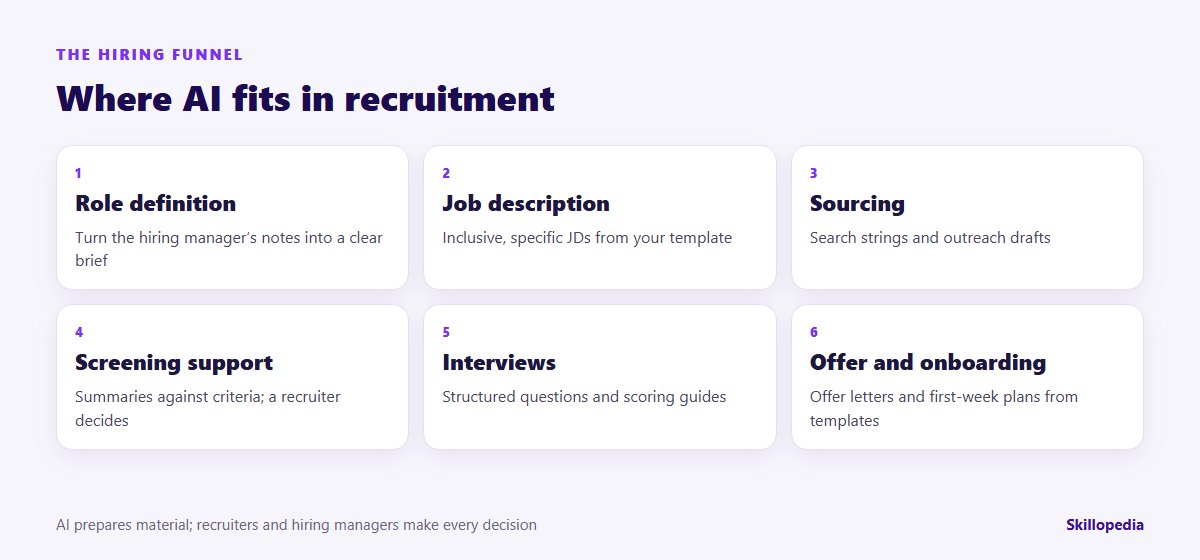
- AI prepares: briefs, job descriptions, outreach drafts, summaries against your criteria, interview kits and letters.
- People decide: who is shortlisted, interviewed, rejected or hired.
Before you start: three rules to agree
- Approved tools only. CVs contain personal data: names, contact details, education, sometimes age, photographs or family details. Use the tool your company has approved on a work account, never a personal chatbot. Under India’s Digital Personal Data Protection Act and the UAE’s Personal Data Protection Law, you need a lawful basis and must protect that data.
- Minimum data. For most tasks, AI doesn’t need names, photos, dates of birth or addresses. Remove them where you can.
- Written criteria first. Agree the must-have and nice-to-have criteria with the hiring manager before AI sees a single CV. This protects fairness and makes every later step faster.
Seven recruitment workflows, step by step
1. Turn the hiring manager’s notes into a role brief
Most poor hires start with a vague request. Use AI to turn notes from an intake call into a structured brief the manager can approve.
2. Write a clear, inclusive job description
Shorter, clearer job descriptions with realistic requirements tend to attract a wider pool. Check the salary range and benefits yourself; never let AI invent them.
3. Sourcing: search strings and outreach drafts
AI can suggest Boolean search strings for job boards and LinkedIn, and draft personalised outreach. Keep messages short, specific and honest about the role, and send them yourself.
4. Summarise applications against your criteria, without ranking
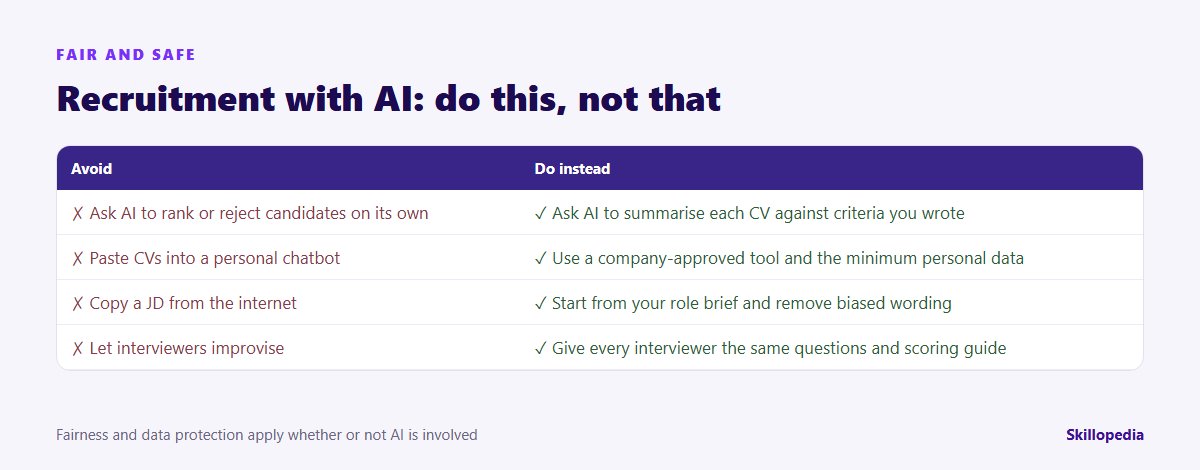
This is where fairness matters most. Ask AI to summarise each CV against the written criteria, and leave the shortlisting decision to the recruiter.
Asking for evidence rather than a verdict keeps the recruiter’s judgement in the loop and makes it easier to explain later why someone was or wasn’t shortlisted. Review candidates who look borderline yourself, and periodically check whether shortlists differ in ways that suggest bias.
Training recruiters and hiring managers together?
5. Build a structured interview kit
Structured interviews, where every candidate gets the same questions and is scored against the same guide, are fairer and more predictive than free-form conversations. AI makes them quick to prepare.

6. Keep candidates informed
Candidates remember silence. AI can draft timely, personalised updates at every stage, including respectful rejections that give a reason where you can.
7. Offer letters and first-week plans
Give AI your approved offer letter template and the agreed terms, and let it fill the document; then check every figure and date against the approval. For onboarding, it can turn the role brief and your policies into a first-week plan for the new joiner and their manager.
Interview notes and AI note-takers
AI meeting tools can transcribe and summarise video interviews. If you use them, tell candidates in advance, follow your company’s rules on recording, and treat the summary as a memory aid rather than the assessment. Scoring should still be done by the interviewer, against the structured guide, soon after the interview.
Measuring the effect
Useful measures include time to shortlist, time to hire, hiring manager satisfaction with shortlists, candidate feedback and the diversity of shortlists compared with the applicant pool. Time each stage for a few weeks before you introduce AI, so you can compare honestly. Our article on measuring the ROI of AI training explains how to keep the figures credible.
A 30-day starter plan for a recruitment team
- Week 1: agree the approved tools, data rules and the “no AI decisions” principle with HR leadership and your data protection lead.
- Week 2: practise role briefs, job descriptions and interview kits on two or three open roles.
- Week 3: add CV summaries against criteria for one role, with a second recruiter checking a sample.
- Week 4: review timings, candidate feedback and shortlist diversity, and decide what becomes standard.
Not every recruiter will start at the same level. An AI skills gap analysis shows who needs what training, and our guide to AI literacy training for employees covers the safe-use basics every recruiter should know.
Recruiters and HR colleagues looking for a structured course can start with our list of AI courses for HR professionals in India.
If you are comparing recruiting software rather than courses, see our list of AI tools for HR professionals, from Indian HRMS platforms to LinkedIn Hiring Assistant.
Questions people ask
Recruitment is one part of HR
About Skillopedia
Skillopedia is a corporate AI training firm, established in 2017, running hands-on programmes for teams across India, the GCC, Africa and Southeast Asia, with on-site and online sessions across the UAE. We have trained 200,000+ professionals from 335+ organisations in 13 industry sectors. More about us