
CLAUDE COWORK PROGRAMMES · LUCKNOW
Claude Cowork Training in Lucknow for Groups That Report From Many Units
Claude Cowork training in Lucknow usually starts with a head-office question: how do we get every unit to produce its numbers and reports the same way, without the MIS team rebuilding them each month? Hospital groups, consumer goods distributors and regional offices of banks and insurers in Lucknow all face it. Skillopedia runs the programme as a firm: one cohort per department, a group usage rule with annexes, a champion in every unit, and day-30 re-timing of real tasks.
- Separate cohorts for operations and MIS, finance, HR and purchase
- Practice folders built from your own redacted unit returns and registers
- Desktop app and Cowork access checked on head-office and unit laptops
- A named facilitator plus a briefed back-up, both met before you sign
- Live online blocks for units outside Lucknow
REPLY WITHIN ONE WORKING DAY
Share your Lucknow requirement
List the departments, how many units or branches report into Lucknow and which Claude plan you use. You hear back within one working day with a proposed format.
Start with how your units report; the fee comes after.
A thirty-minute call about structure: the head office in Gomti Nagar, Vibhuti Khand or Hazratganj, units in Kanpur, Ayodhya, Gorakhpur or Bareilly, and which reports travel between them. A written scope follows, with cohorts, dates, session times and the files each department would redact for its labs.
NAMES FROM OUR CLIENT ROSTER
Some of the organisations that have put their people through Skillopedia programmes
WHY LUCKNOW, WHY NOW
Why Lucknow head offices are a good fit for Claude Cowork
Lucknow is where many organisations run their Uttar Pradesh operations from: hospital groups with units across the state, distributors serving dozens of districts, and zonal offices of banks and insurers. A lot of head-office time goes into collecting returns from units and turning them into one report. Claude Cowork, part of the Claude desktop app and generally available since April 2026, works through a folder of files you give it access to, carries out a multi-step task and saves the result for someone to check. That fits consolidation work well, as long as the rules come first.
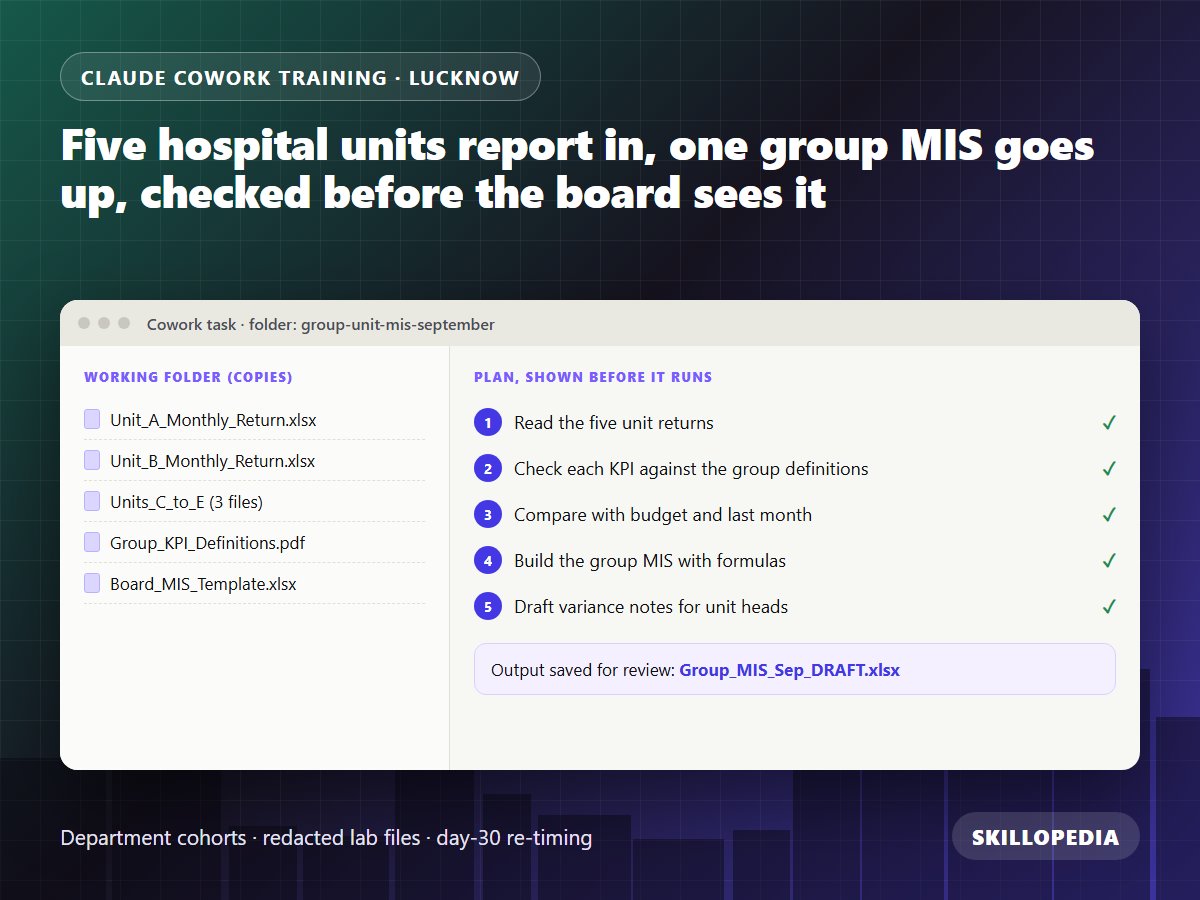
A Lucknow example: a hospital group’s MIS team receives a monthly return from each of its five hospitals, covering department revenue, outpatient and inpatient counts, bed occupancy, average length of stay, consumables spend and staffing. Copies of the returns go into one folder with the group’s KPI definitions. Cowork reads each return, flags any unit that has calculated occupancy or length of stay differently from the group definition, compares every figure with budget and the previous month, builds the group MIS workbook with formulas, and drafts a short variance note for each unit head. Only aggregate counts are used; no patient-level record goes into the folder. The finance team confirms the flagged figures with each unit before the board pack is circulated.
The value is not speed alone. When every unit’s figures are checked against the same definitions, the board discussion moves from “whose number is right” to what the numbers mean. Getting there needs every department trained on the same method, which is what a firm-run programme is for.
WHAT GOES WRONG IN MULTI-UNIT ROLLOUTS
Eight ways a Lucknow Cowork rollout loses momentum after the first workshop
We see these in hospital groups, distribution companies and regional offices alike. Each one is easier to prevent during planning than to fix later.
Different definitions
Each unit calculates occupancy, attrition or sales return rates its own way, so Cowork faithfully consolidates numbers that don't compare.
Head office only
The Lucknow team learns Cowork; unit administrators who prepare the returns never do, so the inputs stay messy.
Health data not ring-fenced
Nobody wrote down that patient records stay out of every folder, so a well-meaning user adds a discharge register.
Generic practice files
The trainer's sample sales sheet looks nothing like a unit MIS return, a purchase register or a duty roster.
The one-person Skill
An analyst builds a consolidation Skill, then moves to another role. No one else knows how it works or who approves changes.
Hindi circulars unchecked
A circular for unit staff is drafted in Hindi and sent without a fluent reviewer reading it against the English original.
Nothing measured
The time taken to close the monthly MIS was never recorded, so there is no way to show what changed.
No plan for the units
The proposal covers a day in Lucknow and stops there: no online blocks, no unit champions, no follow-up date.
None of these is about the tool. Agreed definitions, a group rule with a health-data annex, cohorts for the units and a measurement date fix most of them.
WHO ASKS US FOR CLAUDE COWORK TRAINING IN LUCKNOW
Six types of Lucknow organisation, each with its own plan
Skillopedia’s client roster runs to 335+ organisations in 13 sectors across India, the GCC, Africa and Southeast Asia. In Lucknow, the plan depends mostly on how many units report in, how sensitive their data is, and who must approve the rule.
Hospital and diagnostics groups
Groups with hospitals or diagnostic centres across Uttar Pradesh, run from a Lucknow head office with MIS, finance, HR and purchase teams.
Training implication: a health-data annex comes first; labs use aggregate returns, rosters and purchase files only.
FMCG and consumer distributors
Companies and super-stockists supplying retailers across central and eastern UP, with depot, scheme and sales reporting.
Training implication: depot and sales returns as labs, with retailer details masked and finance checking every reconciliation.
Bank and insurer zonal offices
Zonal and regional offices covering Uttar Pradesh, where reporting, audit follow-up and HR teams serve many branches.
Training implication: compliance signs the rule before labs; customer records stay out and outputs are internal drafts.
Real estate and infrastructure firms
Developers and contractors with projects along Shaheed Path, Sushant Golf City and beyond, handling progress and payment documentation.
Training implication: labs on progress reports and payment schedules, with buyer data excluded and engineers reviewing outputs.
IT and process teams
Technology and back-office teams in Gomti Nagar and nearby areas preparing client reports, SOPs and status updates.
Training implication: client contracts decide what may enter a folder, so the annex is agreed with each account owner.
Universities and school groups
Institutions with several campuses whose administration handles admissions summaries, fee reports and faculty records.
Training implication: student data redacted or left out; labs on fee summaries, timetables and policy documents.
TRAINING TEAM OR SINGLE TRAINER
What a training team adds when Claude Cowork has to reach a whole Lucknow head office and its units
If you are a ten-person firm near Hazratganj, a single capable trainer may be the right choice, and a self-paced course can suit one curious manager. The table matters once several units, a medical or compliance function and a board report are involved.
| What you are deciding | One trainer or a video course | Skillopedia training team |
|---|---|---|
| Reaching every team | A single session at the Gomti Nagar office, while unit administrators in other districts watch a recording later | Repeat sessions with identical labs for each departmentand for every unit in Kanpur, Ayodhya, Gorakhpur or wherever your group operates, run by facilitators certified on the same material |
| Desktop set-up | People arrive without the Claude desktop app or with Cowork switched off, and the first hour goes on installs | Seats, desktop app versions and Cowork access verified for head-office and unit laptops a week before the first cohort |
| Relevance to your work | Generic demo folders chosen by the trainer or the platform | Lab folders rebuilt from your own redacted files: unit MIS returns, purchase registers, duty rosters, branch reports and policy documents, after an NDA |
| What Cowork may touch | Not discussed, or left to each person | A group usage rule with a health-data annex, approved by the medical director, IT and the company secretary |
| If a facilitator is unavailable | The date is lost | A second certified facilitator who already knows your labs takes the session |
| After the workshop | A certificate and a feedback form | The same three tasks per department re-timed at day 30, unit by unit, with a register of the Skills each unit now uses |
| New joiners | Nothing planned | An internal champion prepared to run the new-joiner session with our licensed kit |
| Track record | A personal profile or course reviews | 335+ organisations since 2017 across 13 sectors; 4.8/5 average post-session rating from 300+ surveyed participants |
HOW AN ENGAGEMENT IN LUCKNOW IS BUILT
Six building blocks for a group with units across Uttar Pradesh
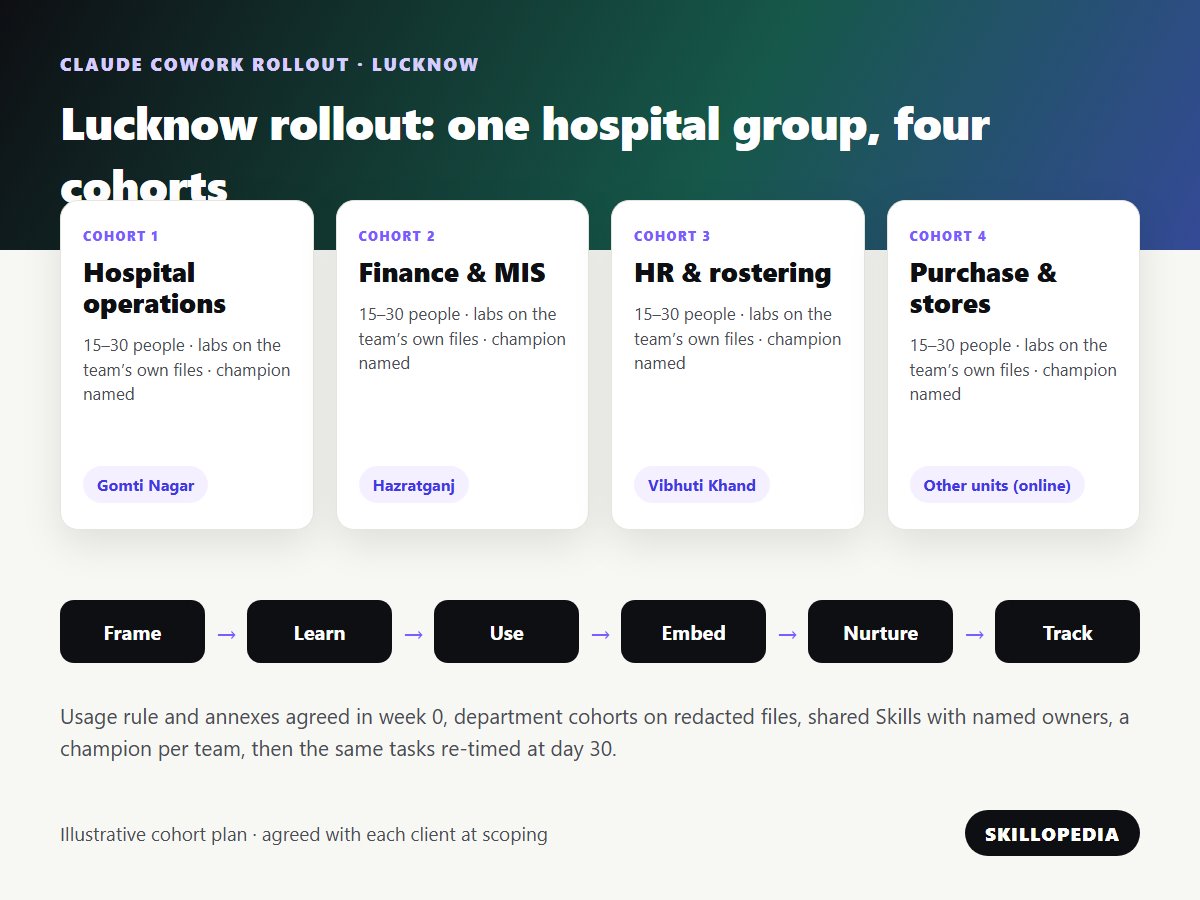
A single Lucknow office usually needs three or four of these. A group with hospitals, depots or branches across the state normally takes all six, sequenced through FLUENT™, our six-stage method: Frame, Learn, Use, Embed, Nurture, Track.
Plan, Desktop and Folder Check
About one week · before any session
We confirm each department’s Claude plan, whether Cowork is enabled, which connectors IT permits, what the health-data annex excludes, how the DPDP Act applies, and which three tasks per department we will time first.
- Seat list for head office and each unit
- Cowork confirmed on every participant's laptop
- Lab folders agreed, with aggregate data only
- Three baseline tasks timed per department
- Draft group rule and annex sent for approval
Department Cohort
15 to 30 people · one department per cohort
The hands-on core, run separately for operations and MIS, finance, HR and purchase, each with labs built from that department’s own redacted returns and registers.
- One department per cohort, 15 to 30 people
- Labs on unit returns, registers and rosters
- Roughly 30% explanation, 70% hands-on
- The department head reviews outputs in the last hour
- Completion certificate for each participant
Unit Cohort
Live online · units across Uttar Pradesh
For unit administrators, MIS executives and branch staff in Kanpur, Ayodhya, Gorakhpur, Varanasi and other locations. Shorter online blocks use the same lab folders as head office, so returns arrive in Lucknow already in the agreed shape.
- Two or three online blocks of about three hours
- Identical lab folders to the Lucknow cohorts
- Unit files used only where the group rule allows
- Facilitator feedback on every participant's output
- A day-30 check reported unit by unit
Leadership Briefing
Half day · decision-makers
For the managing director or CEO, the CFO, the medical or compliance head, HR and IT: which departments and units go first, what Cowork may and may not open, and how results will be judged.
- What each Claude plan offers head-office and unit staff
- Which departments and units should start
- Where health data, customer data and the DPDP Act set limits
- What the Compliance API adds on Enterprise
- A day-30 review date fixed in advance
Skills and Plugins Clinic
1 day · your builders
For the people who will build shared tools: a Skill for the monthly consolidation, plugins that suit finance or operations, and scheduled tasks that prepare the MIS draft, each recorded with an owner.
- A consolidation Skill based on your KPI definitions
- Role plugins for finance, HR or operations
- A scheduled task that drafts, never distributes
- A group register of shared tools and owners
- Reviews timed with the financial year
Champion Handover
1 day · your in-house champions
We prepare a champion at head office and one in each unit to run refreshers with our licensed material. Together they form a small internal network that handles new joiners and keeps practice consistent across the group.
- Licensed refresher kit for head office and units
- One session co-delivered with our facilitator
- Observation feedback against our rubric
- A new-joiner session for unit administrators
- Certification for each champion
WHAT EACH PERSON LEARNS
What operations, finance, HR and purchase teams in Lucknow learn in Claude Cowork
Every participant learns to hand Cowork a consolidation or reporting task and to check the result properly. Department heads set the limits, one or two builders per department learn Skills and plugins, and the person who administers your Claude plan learns the controls. We confirm what your plan includes before the first cohort.
Chat or Cowork?
Everyone: a single question about one unit stays in chat; consolidating five units' returns into a workbook is a Cowork job.
Writing a brief Cowork can act on
Everyone, in depth: a brief that names the returns, the KPI definitions, the output layout and what must be confirmed with units.
Folders and approval settings
Everyone: one folder per consolidation, copies of returns only, and approvals left on during the first weeks.
Checking what comes back
Everyone: tracing each consolidated figure to its unit file and recording who approved the report.
Excel, Word and PowerPoint outputs
MIS and finance: group workbooks with formulas that can be audited, and reports in your board template.
Projects and standing instructions
Teams with monthly cycles: one project per report, with the definitions written once and shared.
Connectors and browser use
IT and compliance: which connectors are allowed near unit data, with browser access kept off.
Skills and plugins
Builders: Skills for consolidation and variance notes, plus finance, HR and operations plugins.
Scheduled tasks
Department heads: the MIS draft prepared on a schedule, reviewed and sent by a person.
Prompt injection and other risks
Everyone: how an instruction hidden in a file could mislead an agent, and why health records stay out.
Admin controls for Cowork
IT: enabling Cowork department by department and unit by unit on Team or Enterprise, with central controls.
Usage limits and plan choice
CFOs: Cowork draws more of a plan's allowance than chat, so which head-office and unit roles need which seat.
We train on the Claude plan you already pay for wherever possible. If some teams use Microsoft Copilot or another assistant as well, the group rule says which tool is meant for which job.
MODULES BY ROLE
Five modules built around head-office consolidation work
Modules 1 to 3 are common to everyone. Module 4 is the operations and MIS lab and module 5 covers finance, HR and purchase. Around 30% is explanation and 70% is hands-on, using your own redacted files.
Module 1: Getting Cowork ready on every laptop
Everyone, at the start: the Claude desktop app on a work laptop, which company account and plan you are in, where Cowork sits, and what the group rule says about unit and health data.
Lab tasks
- Open the desktop app and check the company account and plan
- Copy three redacted unit files into a practice folder
- Leave approvals on and confirm Cowork asks before deleting anything
- Time one consolidation step by hand
- Remove anything the group rule excludes
Module 2: Writing briefs that get a usable first result
Everyone: the outcome, the source files, the format, the checks and the limits, written before Cowork begins. In consolidation work, naming the definitions in the brief prevents most errors.
Lab tasks
- Try "combine these returns", then a full brief on the same folder, and compare
- Give Cowork the KPI definitions file instead of describing it
- Ask for the plan first and change one step
- Save the working brief as standing instructions for the MIS folder
- Exchange briefs with a colleague from HR and run each other's
Module 3: Checking, signing off and sharing safely
Everyone: tracing every consolidated figure back to the unit return it came from, reading what Cowork marked as uncertain, and recording who approved the report.
Lab tasks
- Ask Cowork to show which unit file each figure came from
- Ask about a unit that is missing from the folder and see how it responds
- Compare a Hindi circular with its English source
- Hide an instruction in a sample file to see why approvals matter
- Decide who signs the group MIS before it leaves finance
Module 4: Operations and MIS lab
Group MIS analysts, unit administrators, operations managers and the people who prepare board packs.
Lab tasks
- Consolidate five unit returns into a group MIS with working formulas
- Flag any unit whose KPI calculation differs from the group definition
- Draft variance notes for unit heads from budget and last month's figures
- Turn weekly unit updates into a one-page summary for the CEO
- Set up a scheduled task that prepares the MIS draft on the third working day
Module 5: Finance, HR and purchase lab
Finance, HR and purchase teams who support units across the state from Lucknow.
Lab tasks
- Compare unit-wise purchase rates for the same consumables and list outliers
- Build a duty roster gap report from unit staffing sheets
- Check vendor invoices against purchase orders and goods receipts, listing differences
- Draft an English circular and a Hindi version, then have a fluent colleague review it
- Prepare a unit-wise expense summary from ledger extracts, with formulas you can audit
FLUENT™ APPLIED TO CLAUDE COWORK
Six stages, from the plan check to the day-30 re-timing
Every Skillopedia programme follows FLUENT, our six-stage method. The timeline below suits a Lucknow head office with units across the state, fitted around MIS closing dates.
Frame · week 0
Seats checked for head office and units, aggregate-only lab folders agreed, and three tasks timed per department.
Learn · the cohort
Department cohorts in Lucknow on your own redacted returns, with the department head reviewing outputs.
Use · weeks 1 to 4
Head office and units use Cowork on live consolidation work while champions log questions and gaps.
Embed · shared tools
Briefs that worked become shared Skills for the MIS cycle, each with an owner and an approver.
Nurture · champions
Champions at head office and in each unit certify and run the next refresher while we observe.
Track · day 30
The same three tasks re-timed at day 30, reported for head office and for each unit.
In every Lucknow session: about 30% explanation and 70% practice, on returns and reports people bring from their own department.
RULES BEFORE THE FIRST LAB
One group rule, with an annex for health and customer data
A group with several units needs one rule that every unit follows, plus annexes for the data that needs extra care. Ours covers which folders Cowork may use, that it works on copies, which connectors are on, which approval setting applies, who checks consolidated reports, and how patient, employee and customer data is handled under the Digital Personal Data Protection Act, 2023 and the DPDP Rules notified in November 2025. For hospital groups the health-data annex simply says that patient-level records never enter a Cowork folder. Files Cowork works on are processed on Anthropic’s servers, so check the data-residency position for your plan with Anthropic.
- One rule for head office and every unit, with a health-data annex
- Cowork works on copies in named folders, never on live systems
- Approvals stay on "ask first" until the department head agrees otherwise
- No patient-level records, banking portals, passwords, PAN or Aadhaar numbers in any task
- Scheduled tasks prepare drafts; a person sends, files and pays
- Connectors enabled only where a task needs them
- A group register of shared Skills, plugins and scheduled tasks with owners
- NDA signed before we receive any file; labs use redacted material unless you approve otherwise in writing
WHO RUNS YOUR PROGRAMME
A training firm behind every session: certified facilitators, one rubric, one programme manager
Skillopedia delivers as a firm. Our facilitators are certified on one documented method and you meet them before signing. They rehearse on your lab folders before each cohort and are assessed against a shared rubric, so the MIS cohort in Gomti Nagar and the online block for a unit in Gorakhpur are taught the same way. A programme manager handles seats, rooms, NDAs and reporting across head office and units. Because the method and lab packs belong to the firm, another certified facilitator can step in without your dates moving.
- Skillopedia LLP, set up in Mumbai in 2017
- 335+ organisations on our client roster, across 13 sectors
- Programmes in India, the GCC, Africa and Southeast Asia
- Facilitators from industry and business-school teaching
- One programme manager for head office and every unit
- A champion network handed over before we step back
WHAT PARTICIPANTS SAY
Rated 4.8/5 on average after sessions, from 300+ surveyed participants
“Started using ChatGPT right after the session. Great explanation, shared in a very nice manner.”
Sanjay Mathur
Manufacturing Head · Indorama (Indonesia)
“This program has been incredibly helpful, enhancing efficiency and providing quick, accurate information that supports decision-making and problem-solving.”
Arun Kumar
Engineer · Indorama
“An excellent trainer with deep AI knowledge and a very practical teaching style. The hands-on sessions made learning engaging, clear, and highly useful.”
Aravind Sai
Senior Analyst · Excelacom Technologies
“I would recommend everyone to go through the session, it clarifies what should be expected from AI and where AI is not needed.”
Rahul Arora
Deputy General Manager · Tata Teleservices
“This program was extremely helpful in understanding the practical uses of AI tools. It made learning simple, engaging, and useful for real-life applications.”
Raju Vidhate
Manager, R&D · Emami Agrotech
HOW WE COVER LUCKNOW AND THE UNITS
Head-office cohorts in Lucknow, online blocks for every unit
Lucknow calendars have their own pressure points: month-end MIS closing, quarter-end, the festival season and, for hospitals, the busy monsoon months. We schedule head-office cohorts around them and run unit blocks online so nobody travels from Gorakhpur or Bareilly for one session.
How cohorts are arranged
- At your Lucknow office when one department can fill the room
- The same labs for every department and unit
- Live online blocks for unit administrators
- Dates planned around MIS closing and quarter-end
- Session times that suit unit shift patterns
- One lab pack, one assessment, one group record
QUESTIONS FROM LUCKNOW BUYERS
What CEOs, CFOs and HR heads in Lucknow ask before they start
Yes, as a preparation step. Given copies of each unit’s return and your KPI definitions, it can build a group workbook with formulas, flag figures calculated differently from the definition, and draft variance notes. Your finance or MIS team confirms the flagged items with the units before anything is circulated.
No. For hospital and diagnostics groups the rule includes a health-data annex stating that patient-level records stay out of every Cowork folder. Labs use aggregate counts, rosters, purchase files and policies, redacted where needed.
Yes. Head-office departments train in Lucknow and unit staff join live online blocks built on the same lab folders and assessment. The day-30 report shows each unit separately, so you can see where support is still needed.
Cowork is included in every paid plan: Pro, Max, Team and Enterprise. Groups that want central administration across units generally choose Team or Enterprise, while very heavy individual users may need Max. Cowork uses more of a plan’s allowance than chat, which affects the choice. We set out the options and you decide.
Patient, employee and customer information is personal data under the Digital Personal Data Protection Act, 2023. Your compliance or legal team approves the annex before any lab, and practice files are redacted. Cowork’s files are processed on Anthropic’s servers, so confirm the residency position for your plan with Anthropic. We offer practical guidance, not legal advice.
Skillopedia LLP, a Mumbai firm set up in 2017. We sign your NDA before any file is shared and send a fixed-fee proposal naming the facilitators, with a plan for head office and each unit. Invoices are in rupees, with GST as applicable.
Before the first cohort we time three real tasks per department. At day 30 the same tasks are timed again and the report lists which Skills each unit is using, with any estimate clearly marked. The fee is fixed after scoping and itemised by cohort, unit block and building block.
START WITH A 30-MINUTE CALL
Looking for Claude Cowork training in Lucknow? Begin with how your units report.
Send us the departments involved, the number of units, your Claude plan and a rough start date. After a planning call you receive a written scope with format, timings, dates and facilitator profiles. We answer every enquiry within one working day.