
Claude Cowork training · Singapore · in-house for organisations
Claude Cowork Training in Singapore for Teams That Run the Region From Here
Some of the organisations on Skillopedia’s client roster
What Claude Cowork is, as of October 2026
Claude Cowork in plain terms: chat that finishes the job
Claude Cowork is Anthropic’s agent for everyday knowledge work. It began in the Claude desktop app for macOS and Windows: you give it access to a folder, describe the outcome you want, and it proposes a plan, works through the steps across your files and saves the result, a workbook, a document or a pack, for you to review. It asks before it does anything you have not approved, and you can watch and redirect it as it works.
The product has moved quickly this year. Anthropic’s release notes record three changes that matter for a training plan:
- Paid plans only. Cowork is available on Pro, Max, Team and Enterprise, not the free plan, and it uses a plan’s allowance faster than ordinary chat.
- Beyond the desktop (7 July 2026). Cowork reached the web and mobile apps, running sessions remotely so tasks and files sync to your account. The rollout began with Max.
- Folded into every conversation (16 September 2026). Anthropic now makes everything Cowork does available from any conversation, so you no longer pick a mode before you start. Chats, Cowork tasks, projects, connectors and Skills carry over. The rollout is gradual, starting with Pro and Max.
So depending on your plan and when your admin’s rollout lands, your people may see a Cowork tab in the desktop app or simply hand a bigger task to Claude in a normal conversation. We train the habit that works in both: a clear brief, the right files, approvals switched on, and a human check at the end.
| Use | Chat | Cowork |
|---|---|---|
| Quick question or rewrite | Ideal | More than you need |
| Work across a folder of files | Paste and repeat | Built for it |
| Several steps in sequence | You drive each step | Plans and runs them |
| Saves a finished file | Copy and paste | Workbook, document or pack |
| Plan allowance | Lighter | Heavier |
Source: Anthropic’s Claude release notes and help centre, checked 22 October 2026. Features differ by plan; we confirm yours during scoping.
Who it is for
Built for Singapore teams that check, pair and summarise files all week
Cowork pays off where people spend hours moving between documents that arrive from somewhere else: entity ledgers, carrier files, client folders, board packs. That describes a large share of Singapore’s workforce, because so many firms run regional functions from here. We plan each programme around one of six patterns.
Banks, insurers, wealth and payments firms
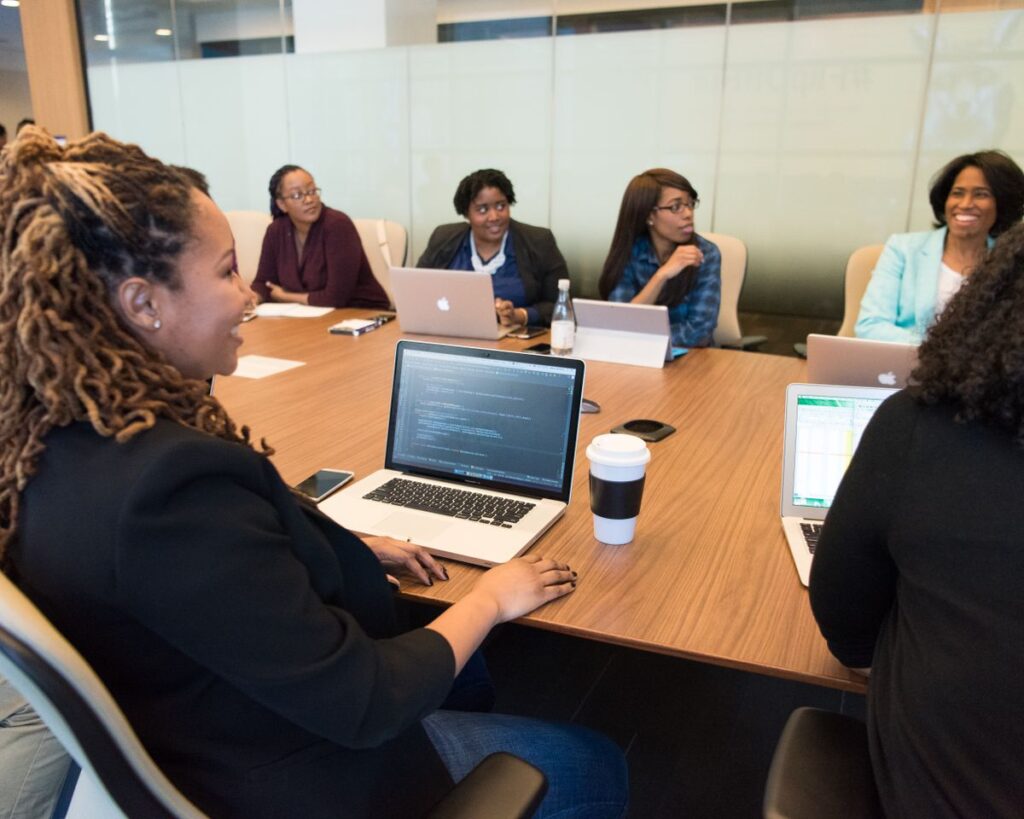
Operations, finance and client-service teams in MAS-regulated firms. We begin with compliance and technology risk, so the rule is approved before any lab, and every exercise uses synthetic or redacted material.
Accounting, legal, consulting and corporate services
Teams that live in client folders and proposal libraries. Engagement letters decide what Cowork may see, so we agree the rule by client type and practise on the firm’s own templates.
APAC HQs coordinating five or more countries
Regional finance, HR and operations teams that collect files from entity offices. Singapore cohorts train in person; country colleagues join online on the same practice folders.
Freight forwarders, 3PLs, shipping and commodities
People who match bookings, carrier updates, invoices and customs documents. Labs centre on exception handling, with customer and counterparty names masked.
Large organisations with mature governance
Many departments, established data classification and procurement rules. The usage rule follows your existing classification, and IT signs off the permitted tasks first.
Companies where a few people run the back office
One mixed cohort for finance, HR and operations, a two-page rule, and two or three workflows that give time back within the first month.
Outcomes
What your team walks out with
- Two or three working workflows per person, built on a task from their own week and saved as a reusable brief or Skill.
- A brief template that names the outcome, the files, the format, the checks and the limits before Cowork starts.
- A review habit: tracing figures to source files, reading what Cowork marked as uncertain and recording who signed off.
- A signed usage rule with a personal-data annex your DPO has approved.
- A shared library of Skills, each with an owner and a review date.
- Named champions in each department who can run the next refresher.
- A baseline of three timed tasks per department, so day-30 results can be compared honestly.
The programme
Six modules, each ending in an exercise on your own files
Modules 1 to 3 are for everyone. Modules 4 and 5 are the department labs, and module 6 is for the people who will build and maintain shared tools. A short demonstration opens each module; most of the time goes to the exercise.
Set-up and safe folders
Signing in to the company account, checking the plan, finding Cowork (a tab or a normal conversation, depending on rollout) and creating a practice folder that holds copies only.
Exercise: copy three redacted files into a folder, time one task by hand, and confirm Cowork asks before deleting anything.Writing a brief Cowork can act on
Outcome, sources, format, checks, limits. Asking for the plan first, then editing a step before Cowork runs it.
Exercise: run a one-line request and a full brief on the same folder, then compare the two results side by side.Checking and signing off
Tracing each figure to its file, testing what happens when an input is missing, spotting a hidden instruction in a document, and recording approval.
Exercise: review a colleague’s output against the source files and log every correction you make.Finance and reporting lab
For accountants, FP&A, treasury and controllers: pairing, restating, variance commentary and pack assembly in your own templates.
Exercise: produce a draft reconciliation or management pack from last month’s redacted files.Operations, client and people lab
For operations, client service, HR and legal: exception packs, proposal refreshes, policy comparisons and status summaries across countries.
Exercise: turn a week of operational files into a reviewed exception summary for your manager.Skills, connectors and scheduled drafts
For builders and admins: packaging a repeat task as a Skill, choosing which connectors stay off, and scheduling drafts that a person reviews and sends.
Exercise: publish one Skill to the team library with an owner, a version note and a test file.Inside a session
What a one-day department cohort looks like
Times are in SGT and move to suit your close calendar. Virtual cohorts split the same content into two or three shorter live sessions.
Singapore worked examples
Four Singapore examples, step by step
These are the kinds of lab we rebuild from a client’s own redacted files. Each shows the inputs, what Cowork does, and where a person stays accountable. They are illustrations of method, not client results.
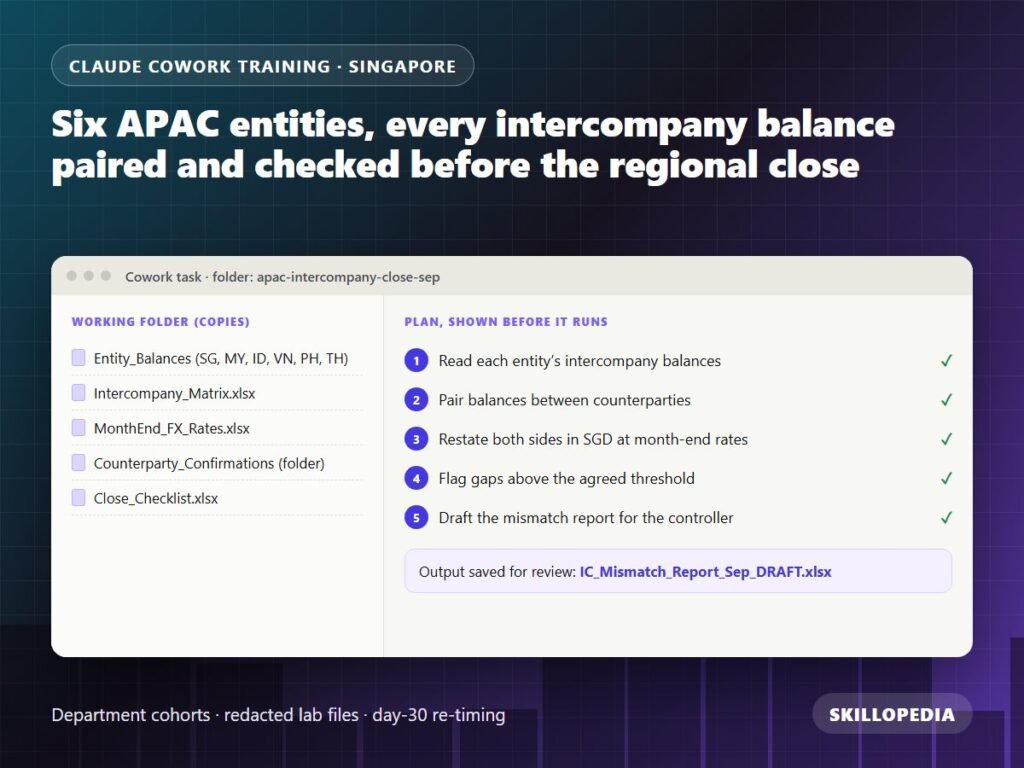
Example 1 · Regional HQ finance: intercompany balances in SGD
A Singapore regional finance team closes six entities: Singapore, Malaysia, Indonesia, Vietnam, the Philippines and Thailand. Before consolidation every intercompany balance must agree with its counterparty.
- Each entity’s intercompany listing, the intercompany matrix, month-end rates and counterparty confirmations are copied into one close folder.
- Cowork pairs each receivable with its payable and restates both sides in SGD at the agreed rates.
- It separates timing and FX differences from true mismatches and flags anything above the controller’s threshold.
- It drafts a mismatch report with one short query per entity accountant.
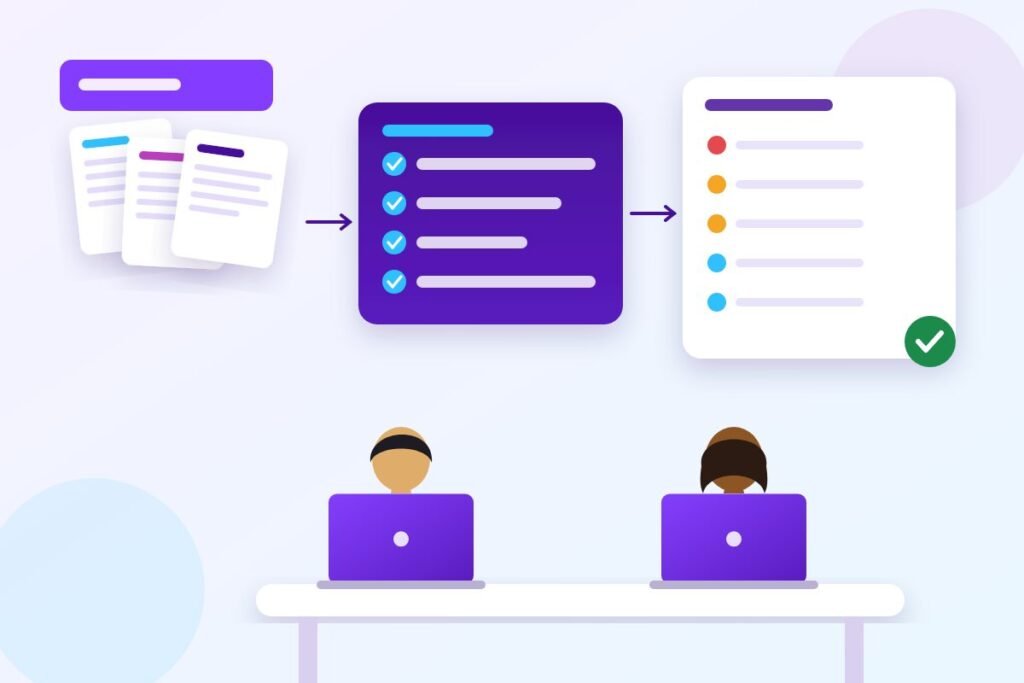
Example 2 · Logistics: the daily shipment exception pack
A freight forwarder’s Singapore control tower starts each morning by finding the shipments that need a call: missed cut-offs, rolled bookings, documents still missing before a vessel departs.
- The overnight booking export, carrier status files, the customs document checklist and open customer requests are copied to a dated folder.
- Cowork matches each booking to its latest carrier status and document set.
- It sorts exceptions by severity using the team’s own rules, for example cargo at risk of missing a vessel versus a late copy of a packing list.
- It drafts the exception pack and a suggested owner for each line.
Example 3 · Professional services: refreshing the proposal library
A consulting or corporate-services firm keeps dozens of past proposals, credentials and team bios. Half are out of date, and the bid team rebuilds them under deadline.
- Approved past proposals, the current service catalogue, team profiles and the brand template go into a library folder, with client names masked.
- Cowork lists every section that cites retired services, old fees or departed staff.
- It drafts refreshed boilerplate in the house template and a change log for each file.
Example 4 · SME: the monthly management pack
A 60-person Singapore distributor’s finance manager builds a management pack every month from accounting exports, the sales tracker and the bank balance summary.
- Last month’s exports and the pack template are copied to a month folder.
- Cowork fills the template, computes variances against budget and last month, and lists anything it could not reconcile.
- It drafts a one-page commentary in plain language for the directors.
Data handling
Personal data, the PDPA and regulated firms
Cowork works on whatever is in the folder you give it, so the real control is what goes into that folder. We write that down before the first lab.
- The PDPA applies to the inputs. Customer, employee and client details are personal data under the Personal Data Protection Act 2012. The annex to your usage rule lists what may enter a folder and what must be removed or masked first.
- Transfer limitation. Claude processes files on Anthropic’s infrastructure, which may be outside Singapore. Your DPO should consider the Act’s transfer limitation obligation and how your contract and plan settings address it.
- PDPC guidance. The PDPC’s advisory guidelines on personal data in AI systems are a sensible reference for your annex, alongside IMDA’s Model AI Governance Framework for Agentic AI, updated in May 2026, which stresses human accountability for what an agent does.
- MAS-regulated firms. Banks, insurers and other financial institutions also apply their own technology risk and outsourcing requirements. MAS issued Guidelines on AI Risk Management on 7 October 2026, taking effect from October 2027, which expect an inventory of AI use, a materiality assessment and lifecycle controls, including for third-party AI. We fit the programme to the controls you already run.
Before we receive any file
- We sign your NDA.
- Labs use redacted or synthetic material unless you approve otherwise in writing.
- No NRIC numbers, Singpass, banking portals or passwords in any task.
- Approvals stay on while people learn.
Usage-rule template
The outline of the usage rule we draft with you
| Section | What it says |
|---|---|
| 1. Scope | Which teams, countries and Claude plans the rule covers, and who owns it |
| 2. Permitted tasks | The approved task list per department, with examples |
| 3. Folders and files | Named folders only, copies not originals, never inside the ERP or client systems |
| 4. Personal-data annex | What may enter a folder, what must be masked, and how the PDPA’s obligations apply |
| 5. Approvals and connectors | Which approval setting applies, which connectors are on, and who can change them |
| 6. Review and sign-off | Who checks an output before it leaves the team, and how that is recorded |
| 7. Skills and scheduled tasks | A register with owners and review dates; scheduled tasks prepare drafts and never send |
| 8. Incidents and review | What to do if something goes wrong, and when the rule is next reviewed |
For regional headquarters, one rule covers Singapore and every country team, with local annexes where a country’s own law adds requirements.
Formats and duration
Choose a format that fits the team
| Format | Length | Suits | Delivery |
|---|---|---|---|
| Leadership briefing | Half day | Regional CEO, CFO, DPO, HR and IT heads | On-site or virtual |
| Department cohort | 1 day | One department of 15 to 30 | On-site, or two to three virtual sessions |
| Regional cohort | 2 or 3 live sessions of about 3 hours | Country teams reporting into Singapore | Virtual, timed for UTC+7 to UTC+9 |
| Builders clinic | 1 day | People who will maintain Skills and scheduled drafts | On-site or hybrid |
| Champion handover | 1 day | One champion per department or country | On-site or hybrid |
| Rollout programme | 4 to 10 weeks | Several departments and countries | A mix of the above, sequenced through FLUENT |
In person at your premises anywhere in Singapore, from Raffles Place and Marina Bay to one-north, Jurong and Changi Business Park, or at a venue you choose. Hybrid sessions link the Singapore room with regional offices.
Get a proposal
Tell us which teams, which countries and which plan
Send the form and we reply within one working day. After a short scoping call you receive a written proposal with:
- the cohorts, formats and dates, with SGT session times
- the files each department should prepare, and how to redact them
- a draft outline of your usage rule and personal-data annex
- the facilitator profiles and a fixed, itemised fee
Request a Claude Cowork proposal
Reply within one working day. No obligation.
How an engagement works
Six stages of FLUENT, from plan check to day-30 review
Every Skillopedia programme follows FLUENT, our six-stage method. For a Singapore office with regional teams, it usually runs like this.
Champions network
Champions keep Cowork useful after the trainers leave
Adoption fades when the one person who understood the Skill moves on. So we prepare a champion in each Singapore department and, for regional headquarters, one in each country team. Together they form a small network that keeps briefs, Skills and folder conventions consistent.
- A one-day handover with our licensed refresher material
- One refresher co-delivered with our facilitator, then one they run alone
- Feedback against the same observation rubric our facilitators use
- A monthly 30-minute clinic slot for questions from their teams
- A new-joiner session they can run without us
Measuring adoption
How we measure progress without inventing numbers
We do not quote hours saved before we have timed anything. Instead, the measures are agreed in week 0 and reported from your own data.
| Measure | How it is collected | Reported at |
|---|---|---|
| Time per task | Three real tasks per department timed by hand in week 0, then with Cowork | Day 30 |
| Workflows in use | Champions confirm which workflows each team still runs | Day 30 and day 60 |
| Rework rate | Corrections logged at review, as a share of outputs checked | Day 30 |
| Skills maintained | Entries in the Skills register with a current owner and review date | Day 60 |
| Rule compliance | Spot checks of folders against the personal-data annex | Day 30 |
| Participant feedback | Post-session survey on usefulness and confidence | After each cohort |
Your options
In-house training, public courses or self-learning?
Singapore has good options for individuals. Some providers run one-day public Claude Cowork bootcamps for mixed groups, usually asking each participant to bring their own Pro subscription. Several institutes offer broader generative AI courses that include Claude, some of them SkillsFuture-eligible, and there are free community meetups and Anthropic Academy’s free self-paced courses. Here is how they compare for a team.
| Question | Public course or bootcamp | Self-learning | Skillopedia in-house |
|---|---|---|---|
| Whose files are used? | Sample files, or your own on a personal account | Your own, without a review habit | Your redacted files, under your company plan |
| Usage rule and PDPA annex | Not usually covered for your firm | None | Drafted with your DPO before the first lab |
| Regional colleagues | Each person enrols separately | Uneven | Same labs online for every country team |
| Follow-up | Ends with the class | Up to the individual | Champions, a Skills register and a day-30 review |
| Suits | Individuals and very small teams | Curious early adopters | Departments of 15 or more, or a region |
Funding
Is this SkillsFuture-funded? An honest answer
No. Skillopedia’s in-house Claude Cowork programme is a private corporate engagement, and we do not claim SkillsFuture Credit, course-fee subsidies or any other Singapore government funding for it. Companies usually pay from their L&D or transformation budget. If funding is a deciding factor for you, check the provider’s listing on the MySkillsFuture course directory before you enrol in any course. We are happy to send an itemised quote and outline your finance team can assess on their own.

What participants say
Rated 4.8/5 on average by 300+ surveyed participants
“Started using ChatGPT right after the session. Great explanation, shared in a very nice manner.”
“I would recommend everyone to go through the session, it clarifies what should be expected from AI and where AI is not needed.”
“This program was extremely helpful in understanding the practical uses of AI tools. It made learning simple, engaging, and useful for real-life applications.”
Comments are from Skillopedia AI programmes generally, not only Claude Cowork. More on our testimonials page.
FAQ
Claude Cowork training in Singapore: questions buyers ask
What is Claude Cowork training in Singapore?
It is a private, hands-on programme that teaches your teams to hand Claude Cowork a multi-step task on their own files, such as a reconciliation, an exception pack or a management pack, and to check the result before it is used. Skillopedia delivers it for organisations in Singapore, on-site, virtually or hybrid.
Is Cowork still a separate mode after the September 2026 update?
Anthropic’s release notes for 16 September 2026 say everything Cowork does is now available from any conversation, rolling out gradually to Pro and Max first. Some users will still see a Cowork tab in the desktop app until their rollout lands. The training covers both.
Which Claude plan do we need?
Cowork needs a paid plan: Pro, Max, Team or Enterprise. Organisations that want central administration usually choose Team or Enterprise. Cowork uses a plan’s allowance faster than chat, which affects which roles need which seat. We set out the options during scoping; you decide.
Is Claude Cowork the same as Cowork in Microsoft 365 Copilot?
No. Microsoft 365 Copilot has a separate feature also called Cowork. This programme covers Anthropic’s Claude Cowork. If your company uses Copilot as well, the usage rule can say which tool is meant for which kind of work.
Can we use our own files without breaching the PDPA?
Yes, with preparation. The usage rule’s personal-data annex lists what may enter a folder and what must be masked first, practice files are redacted, and your DPO considers the transfer limitation obligation because files are processed outside your systems. This is practical guidance, not legal advice.
We are MAS-regulated. What changes?
Compliance and technology risk approve the rule before the first lab, all practice material is synthetic or redacted, and the programme is fitted to your technology risk, outsourcing and AI risk management controls, including MAS’s Guidelines on AI Risk Management issued on 7 October 2026.
Is the training on-site or online, and in what time zone?
Either, or both. Most Singapore cohorts run in person at your premises or a venue you choose. Virtual cohorts and hybrid sessions are scheduled in SGT (UTC+8), with regional sessions timed for colleagues between UTC+7 and UTC+9.
Can colleagues in Malaysia, Indonesia or elsewhere in APAC join?
Yes. Country teams join live online sessions on the same practice folders and assessment as the Singapore cohorts, and the day-30 review reports each country separately.
How long does a programme take?
A leadership briefing is half a day and a department cohort one day. A full rollout across several departments and countries usually runs four to ten weeks, including the champion handover and the day-30 review.
Is this programme SkillsFuture-funded?
No. We do not claim SkillsFuture Credit, course-fee subsidies or other Singapore government funding for this private programme. Companies usually fund it from their training budget.
Do participants receive a certificate?
Yes, a Skillopedia certificate of completion. It is not an Anthropic certification, and Skillopedia is an independent training firm.
How do you measure whether it worked?
We time three real tasks per department before training and again at day 30, track which workflows are still in use and how many outputs needed correction, and report by department and country. We do not publish estimates as results.
Do you run public classes for individuals?
No. We train organisations in private cohorts. Individuals may find a public course or Anthropic Academy’s free self-paced material a better fit.
Who do we contract with, and how is it priced?
You contract with Skillopedia LLP, a corporate AI training firm founded in Mumbai in 2017. After scoping we send a fixed fee itemised by cohort, regional session and building block, and we sign your NDA before receiving any file.
Related
More Skillopedia training for Singapore teams
Next step
Start with one real workflow from your Singapore team
Tell us the departments, the countries involved, your Claude plan and a preferred start date. We reply within one working day with a proposed format, and after a scoping call you receive a written proposal with SGT timings and a fixed fee.
- Private cohorts on your own redacted files
- A usage rule with a PDPA-aware annex
- Champions and a day-30 review built in
Request a Singapore proposal